
Unlocking the Value of Real Estate Assets: The Importance of Professional Management

Unlocking the Value of Real Estate Assets: The Importance of Professional Management
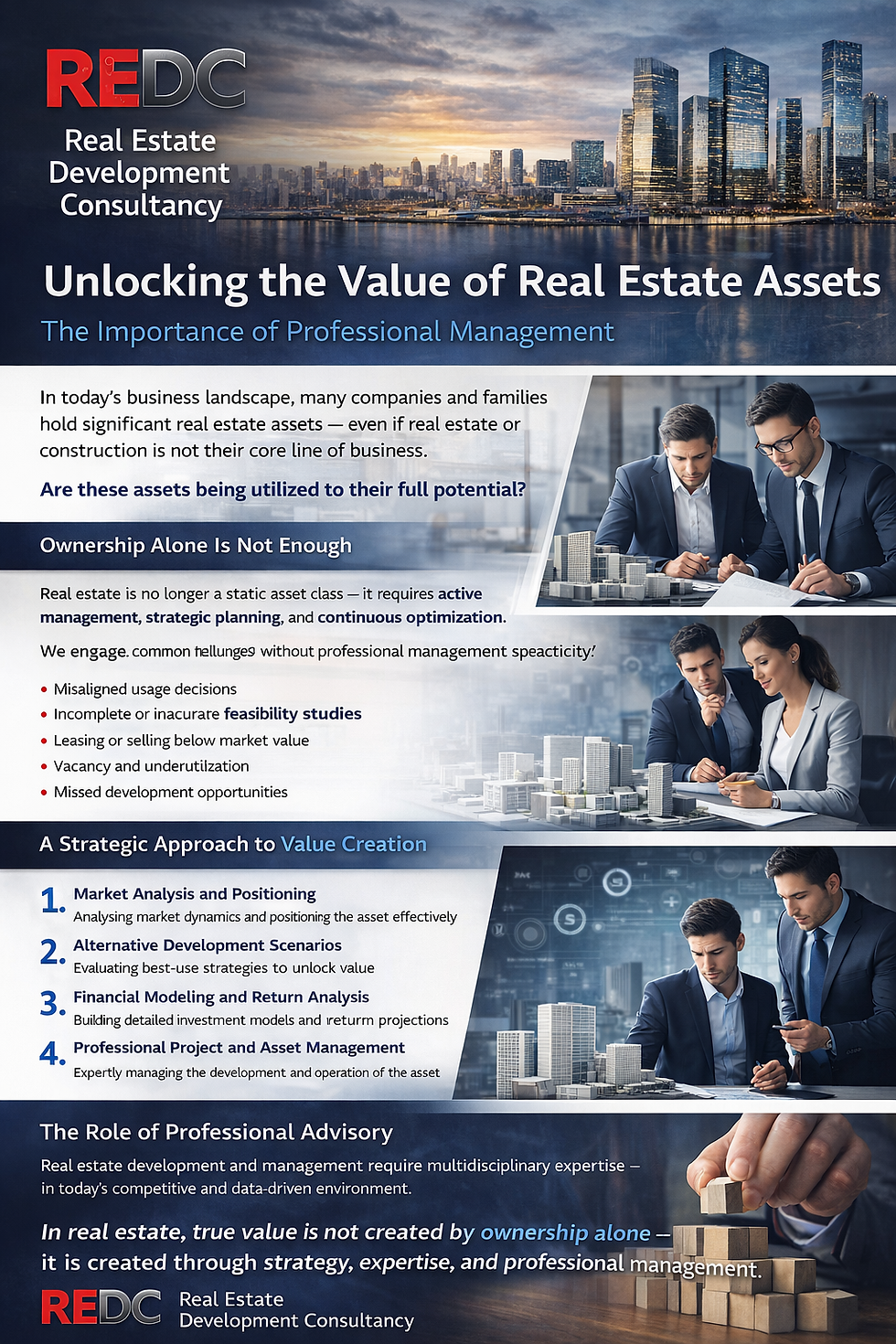
In today’s business landscape, many companies and families hold significant real estate assets — even if real estate or construction is not their core line of business. These assets may include corporate headquarters, land holdings, or income-generating commercial properties.
However, the key question remains:Are these assets being utilized to their full potential?
Real estate, when strategically managed, can become a powerful and sustainable source of value.When managed passively, however, it often turns into an underperforming asset — tying up capital while delivering suboptimal returns.
Ownership Alone Is Not Enough
For many organizations and families, real estate is perceived as a “safe asset” to hold. This mindset often leads to passive management.
Yet in today’s investment environment, real estate is no longer a static asset class — it requires active management, strategic planning, and continuous optimization.
Without a professional approach, common challenges include:
Misaligned usage decisions (residential vs. commercial vs. mixed-use)
Incomplete or inaccurate feasibility studies
Leasing or selling below market value
Vacancy and underutilization
Missed development opportunities
These issues not only reduce income potential but can also erode long-term asset value.
A Strategic Approach to Value Creation
Unlocking the true value of real estate assets requires a structured and disciplined approach:
1. Market Analysis and PositioningUnderstanding supply-demand dynamics, target segments, and competitive positioning at a micro-market level is essential.
2. Alternative Development ScenariosThe current use of a property may not be the highest and best use. Evaluating multiple development options is critical to identifying the optimal strategy.
3. Financial Modeling and Return AnalysisEach scenario should be supported by detailed financial modeling, including investment costs, cash flow projections, return metrics, and risk assessment.
4. Professional Project and Asset ManagementFrom development through operations, professional management ensures that both construction and long-term performance are optimized.
The Role of Professional Advisory
Real estate development and asset management require multidisciplinary expertise — spanning finance, legal, planning, design, and operations.
For companies and families outside the real estate sector, engaging professional advisory services is not a luxury — it is a necessity.
A structured advisory approach:
Provides objective asset evaluation
Identifies hidden value creation opportunities
Anticipates and mitigates risks
Builds data-driven, optimized strategies
Conclusion: Value Is Created Through Management
Real estate may inherently be a valuable asset.But transforming that value into sustainable income and long-term growth depends entirely on how it is managed.
In today’s competitive and data-driven environment, the key question is no longer:“Do we own real estate?”but rather:“Are we managing it in the most effective way?”
Because in real estate, true value is not created by ownership alone —it is created through strategy, expertise, and professional management.
What interests me about introducing social learning through school projects is how a broad idea becomes part of an ordinary day. A shared project can give pupils a reason to explain their thinking to someone else. I would keep that thought nearby when looking for ideas about social learning projects. A short discussion of an everyday example would make this easier for me to connect with, especially as someone still learning about the subject. What helps students learn from one another instead of only dividing up the work?
A conversation about finding a comfortable rhythm for school learning seems most useful to me when it leaves space for uncertainty and further questions. Small consistent habits can help pupils return to a task after a distraction. It gives me a more concrete starting point for thinking about school learning routines. I am still thinking through the details, and a small example would help me picture how this works in practice. Which routines encourage focus while still allowing an occasional change of pace?
I can see why building confidence through adult education would invite discussion, since different people will bring different experiences to the same question. A practical learning goal can make returning to a classroom feel more purposeful. I would keep that thought nearby when looking for ideas about adult skills courses. A short discussion of an everyday example would make this easier for me to connect with, especially as someone still learning about the subject. What would help an adult learner recognise progress early in a course?
My first thought about developing confidence in language practice is that the everyday experience deserves as much attention as the larger explanation. A low-pressure conversation can help a learner use words they recognise but rarely say aloud. This is why I would approach language practice confidence with a specific question rather than a fixed expectation. I do not have a settled view yet, but this seems like a good place to slow down and look more closely. Which activities encourage speaking without making every mistake feel important?
When it comes to supporting teachers through shared learning resources, I would rather understand one useful detail properly than rush through a long list of ideas. A resource becomes more useful when it includes enough context for another teacher to adapt it. That is the kind of detail I would keep in mind while exploring teacher learning resources. I am more curious about the process than a polished result, because the steps in between are usually where questions appear. What information would you include when sharing an activity that worked in your classroom?